
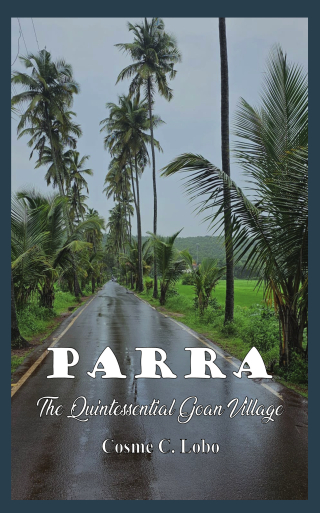
 Author Cosme Lobo takes readers on a nostalgic journey through the Bardez, Goa, village of Parra’s lanes — revisiting traditions, festivals, people, and places that shaped its identity. Through stories, photographs, and lived experiences, the book captures the soul of a village where every stone has a story and every breeze carries whispers of the past.
Whether you're a Goan at heart, a lover of local history, or simply curious about the hidden corners of India, this book invites you to take a walk down memory lane — and rediscover the magic of a village that still lives in the hearts of many.
Nestled among swaying coconut palms and little lanes, Parra was once famed for its lush green fields, watermelons, and the sweet scent of jackfruit and tamarind trees, Parra has witnessed the quiet passing of time and the stirring winds of change.
Parish priest Pedro da Gama writes in the foreword: "The book Parra, The Quintessential Village written by Cosme C. Lobo gives in a nutshell information about the scenic village of Parra. He gives information on the various subjects of the village of Parra, viz., its history, geography, land, fields, hills, water bodies, Church, chapels, educational institutes, religious houses, temples and above all its people and their traditions – social, cultural and religious.
An example of what the book contains:
The landscape of Parra is a departure from the undulating Bardez topography; it is a sandy plain with palm-fringed roads separating the paddy fields from inhabited areas.
Parra is an archetypal Goan village bordering Mapusa, Guirim and Nagoa, while also being hedged by Assagoa, Anjuna and Arpora by fruit bearing and other type of trees. Previously, there used to be plenty of cashew and kokum trees, and berry bushes too. Now, our hillocks are mostly covered by non-fruit bearing wild trees. Although it is undergoing a facelift, Parra has a rich and authentic heritage, which the people of Parra or Porrikars hold close to their hearts. In the past, Parra was famous for its lush watermelons, besides chillies, onions and other vegetables. The sandy soil is conducive to the growth of watermelons; very few grow the crop now. This sandy soil of Parra leads one to believe that in the days gone by, it was a bed of a river. It is possible that the affluent of the river of Baga, which is at present up to Arpora may have extended into Parra. Parra was also famous for its lakes and ponds. Our village elders, especially the comunidades of Parra, Verla and Canca took great pains to maintain bunds and drains in Parra. Hence, there isn’t any waterlogging in Parra, however heavy the rain may have been.
TABLE OF CONTENTS
Foreword 1
Prologue 3
1. A Brief History And Geography Of Parra 9
2. Religious Harmony 23
3. The Church Of Parra 39
4. Priests Down The Ages 56
5. Priests And Nuns From Parra 60
6. Traditional Life Of Porrikars 69
7. Chapels In Parra 89
8. Traditions In Parra And People Who Helped To Keep Them Alive 96
9. People Who Have Contributed To Make Parra What It Is 115
10. Events And Developments Of Change 130
11. Institutions In Parra 144
12. Beacons Of Prominence 156
13. Freedom Fighters From Parra 175
14. Our Tiatrists 183
15. Education In Parra 195
16. Our Progressive Farmers And Farmlands 206
17. Our Sports Ambassadors 220
18. Our Political Leaders 235
19. Trend Setters 245
20. Urban Legends: Spooky Or Mysterious 262