
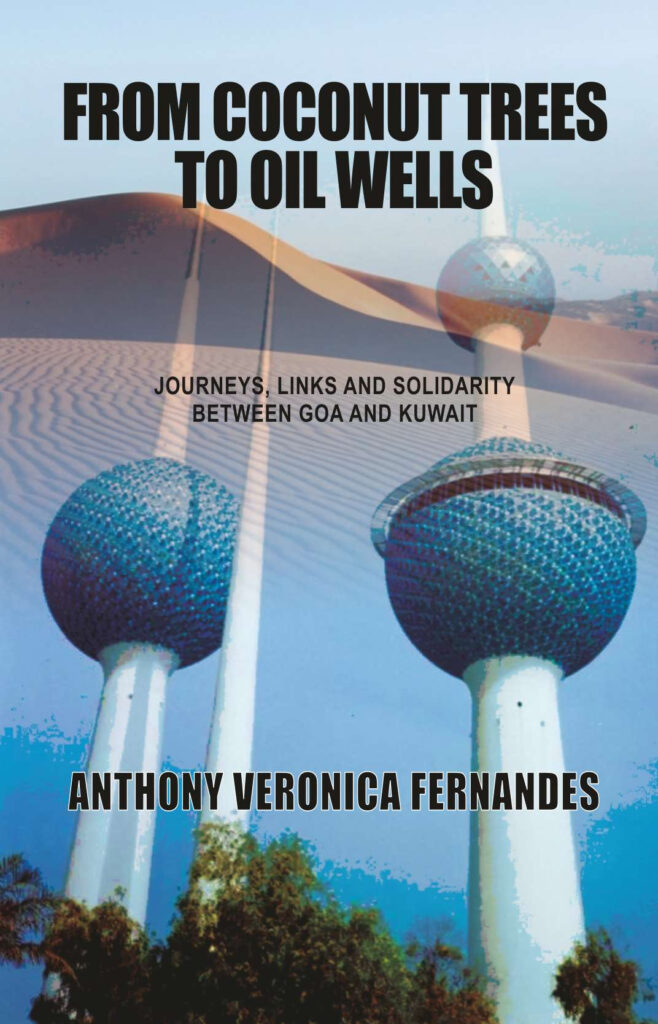
Dedicated to all those Goans who created wealth – and brought prosperity home – through their sweat and tears shed in distant shores, particularly in Kuwait. Their contribution still awaits being acknowledged, and their concerns understood.
This book tells the story of the 1990 Iraqi invasion of Kuwait, as seen from a Goan perspective.
It also glances back at Goan immigration to Kuwait over the ecades. It narrates how a people from a tiny region along the west coast of India move to the Emirates in West Asia with the six largest oil reserves in the world.
QUOTE
It is an undeniable fact that the economy of Goa, as also the prosperity of many a Goan, got a boost due to the migration of a significant number of Goans to Kuwait since not long after the end of World War II. We may still not know the exact contribution of these Goans, or how big exactly are their numbers* . But the fact that they have contributed immensely can never be doubted. Goans had the distinction of reaching Kuwait pretty early on in the day. They started migrating for job opportunities opening up there immediately after World War II.
The early Goans who came to this country of 17,820 square kilometers starting arriving from the early 1950s. They were recruited from India’s commercial capital of Bombay (now Mumbai), through enterprises like Gray Mackenzie. This firm traces its roots to the British-owned merchant company started in 1883 by Gray Paul, which changed its name to Gray Mackenzie after a merger in 1936, and later became the Bahrain Maritime and Mercantile International to finally just settle for the acronym BMMI.
Others arrived in Kuwait directly from Goa too.
The English-language schools of Goa
Most of these Goans who migrated were the products of Portuguese schools. Some, though, had passed out from the early English-medium schools in Bardez like St Joseph’s at Arpora (the first English-medium high school in Goa, established in 1887) or Mater Dei Institution, Saligao. The latter, founded in 1912, was another of the early schools whose medium of instruction helped the residents of Portuguese-ruled Goa to migrate in those times to colonies run by the British.
St. Joseph’s was reputed to have very high standards then. The motto of this school, which has was inscribed in Latin on its calendar read Cibaria Necessaria Sum ite et Abite (Take The Necessary Food And Depart.). It created fulsome talent in its students, not only through its academic regimen and studies but also through other extra curricular activities, particularly sports.
Topmost Goan sportsmen in all fields, especially in athletics, were often the products of this school. As an aside, this writer too attained the distinction of being the fastest runner of Goa at the time, and also an individual champion at the all Goa Inter School Athletics Meet conducted at the Tembi Ground in Anjuna, Bardez, way back in 1966.
Goans of Al Ahmadi
Goans who arrived early in Kuwait reached there by ship, and the vessels would then dock behind what is now Seif Palace. Due to lack of proper berthing facilities, the ship would dock in the mid-sea and small launches would bring the passengers in from there. Passengers would disembark opposite the Grand Mosque in Kuwait City, now best-known for its watch tower, covered in blue tiles and with a roof plated in pure gold.
According to some elders, the demand for labour during those days was so high that some of the prospective employers would stand in a queue near the Customs point to seek the services of the newcomers. The headquarters of Kuwait National Petroleum Company is in Al Ahmadi. Locally, it is called the ‘home of KOC’ because of the large number of Kuwait Oil Company
refineries located there. Online sources put its current
population at 394,000.
This town was founded in 1946 with the discovery of oil there, and is located in the Al Ahmadi Governorate of Kuwait. It is located in the south of the country, and contains the headquarters for the Kuwait Oil Company. It is known for its oil refineries and green surroundings. Early Goans who were employed and resided at Al Ahmadi had lot of extra curricular activities going on amongst themselves. By nature, Goans tend to be an easy-going people, due to which they are get called
susegad. This word is sometimes loosely translated as laid-back, but is derived from the Portuguese word sossegado (‘quiet’).
Goans are also very prone to immersing themselves in extra-curricular activities. For example, under the aegis of the first Goan association to be set up in Kuwait known as the Goan Association Ahmadi, Goans would perform their socials, cultural and sporting activities. Some of the finest footballers who played KOC-organised tournaments at Ahmadi were members of the Goan community too. People often spoke of the late Alexinho Fernandes from Khobravaddo, Calangute and Stanley from Siolim, considered two of the finest Goan players who played against and with Britons and other Europeans.
Both Alexinho and Stanley, during their heydays in Goa, were exceptionally talented players. Stanley, before migrating to Kuwait, had been selected for the Bardez Goa XI team along with my late brother Jose Maria – an ex-Sesa Goa player, during the Portuguese times – despite of the stiff competition from the top Portuguese players then active on the sports field in Goa.
In the sphere of cultural and traditional activities, other annual socials were organized by the Goan Association Ahmadi. Goan dramas (and tiatrs) were also staged. Some Goans of those days were of such a high caliber in the world of drama that they even staged original English plays, including Shakespearean ones. A detailed account of those times, specially in Ahmadi, awaits to be written; the author understands it is in the process of being done by some of the children of early Goan settlers in this place.
Differing points of view
Many Goans then working and residing at Ahmadi were staunch supporters of the Portuguese rule in Goa. Some were rather politically conscious. They did not like the idea of Goa getting dissolved into the big ocean of India, called Bharat.
Some of these Goans had lived in Bombay and other parts of India and had witnessed how corrupt life was already getting to be there. They noticed the difference between Goans and other Indians. If Goa got annexed by Bharat, their fear – and one which later shown to be not unfounded – was that the charm of Goa and genuine Goans would disappear from Goa. Not just this, they feared that the whole of Goa would get de-Goanised by the free and unhindered influx from other states. Through this process, it was feared, Goa would be inundated. These Goans preferred a separate identity for Goa, but surely not the merger of Goa with Bharat; for that matter, they did not want to continue under the domination of Portugal either. For the time being and till a suitable solution was found, these Goans preferred the status quo.
Some of them have loudly said that they did not want Goa to remain colony of Portugal, but neither did they want Goa to become a colony of Bharat in the name of the freedom for Goa. These Goans did not want Goans to be ruled by Portuguese overseers from Portugal, nor did they want Goans to be under the domination of Bharati supervisors lacking an understanding of things Goan – whether cultural, in terms of traditions, historical, spiritual or linguistic. These Goans anticipated that non-Goan Indians who would descend on to Goa, would occupy every available avenue and venue, and become artificial citizens of Goa. In hindsight, one can say this is exactly what is happening now in Goa.
The other group of Goans who opposed the first group were all for Bharat’s annexation of Goa, either peacefully or by force. This group of Goans wanted Portugal’s ouster from Goa as soon as possible. These Goans were mainly the settlers from Bombay and other parts of India. They accepted the corrupt life of Bharat by being submerged into this way of life elsewhere in India. Politically, the Kuwait Goans of those days were highly conscious and their political opinions used to come to the fore on the National Day of Portugal.
Antonio Marie Fernandes was an expert auto-electrician working at the KOC, Ahmadi. He was a highly politically active Goan from the Pinto Vaddo of Candolim, in Goa’s coastal taluka of Bardez. The village of Candolim and the Pintos’ Vaddo, also called the Pintos’ Ward, itself has a hoary past. It gave birth to the world-famous Father of Hypnotism Abade Faria (or Abbé Faria), whose magnificent statue – a remarkable piece of sculpture by master sculptor Ramchandra Pandurang Kamat – stands on a tall pedestal near the Old Secretariat at Panjim.
Coming from the same village and same ward in Goa, I had myself done my primary schooling at the Portuguese school in Candolim named the Escola Primária de Abade Faria, after this great hypnotist. The house where Faria was born was just next to our Portuguese school. As a small boy, I would enter this deserted house which was then full of snakes, other creepy-crawlies and birds, but it was also rich in fruit-bearing trees. The home itself was in a condition of total neglect, lying decrepit and uninhabited. Its huge big stone walls kept telling us that this house belonged to some great person.
Home of the Abbé
This great person was none other than Father of Hypnotism, Abade Faria who, like his father, ironically, was also a priest by vocation. Incidentally, their’s was an unusual case in Roman Catholicism where both father and son ended up becoming priests and performing their priestly
vocations simultaneously. In our childish ways, some of us as young students used to embrace the big stone walls of this house, under the belief that this act could grant us some inspiration from Abade Faria.
Globally, the contribution of Abbé Faria (1756-1819) is well recognised today. The Goan Catholic abbot was one of the pioneers of the scientific study of hypnotism, following on from the work of the German eighteenth century physician Franz Mesmer. Unlike Mesmer, who claimed that hypnosis was mediated by ‘animal magnetism’, it is now accepted that Faria understood that it worked purely by the power of suggestion.
In the early 19th century, Abbé Faria introduced oriental hypnosis to Paris.§ He was one of the first to depart from the theory of the ‘magnetic fluid’, to place in relief the importance of suggestion, and to demonstrate the existence of ‘auto-suggestion’. He also established that what
he termed ‘nervous sleep’ belongs to the natural order. From his earliest magnetizing séances, in 1814, he boldly developed his doctrine. Nothing comes from the magnetizer; everything comes from the subject and takes place in his imagination generated from within the mind. Magnetism is only a form of sleep. Faria changed the terminology of mesmerism. Previously, the focus was on the
‘concentration’ of the subject. In Faria’s terminology the operator became ‘the concentrator’ and somnambulism was viewed as a lucid sleep. The method of hypnosis used by Faria is command, following expectancy. The theory of Abbé Faria is now known as Fariism.
This village Candolim and its Pintos Ward carries another distinction: that of producing some of the greatest revolutionaries of Goa. These revolutionaries got named after themselves the Pintos’ Revolt against Portuguese rule in Goa, way back in the eighteenth century. Befitting their greatness, their name is given to this ward. Incidentally the first known revolutionaries who fought for Goa’s Liberation were the Goan Catholics, and their contributions for the freedom of Goa from Portuguese rule is second to none. Goan Christians have shown a greater affiliation, love and patriotism to Goa, even if at times their contribution and their patriotism gets unnecessarily and unfairly doubted.
During the British Raj in Bharat, António Marie Fernandes, who became a very good friend of mine in the 1960s, had worked for British Army in western India. He was a very knowledgeable and well-read man. On one fine day, Portuguese National Day in 1959, António, while employed at the KOC in Kuwait, collected like-minded Goan friends and colleagues at the KOC Centre and hoisted the Portuguese flag. They rendered the Portuguese national anthem – Heróis do mar…. This was done as an expression of solidarity with the Portuguese Government which was then ruling in Goa.
One of the Goans who attended this flag hoisting ceremony stayed on long in Kuwait. Santano Carvalho was from Raia, Salcete, and an ex-Arporite who, recorded history tells us, was the best goalkeeper the Arpora school has ever produced. Though António was criticized by the other groups of Goans and other Indians, he was lavishly praised by the Goans opposed to a Goan merger with
Bharat. News of this small event reached the British Embassy and, from there, it went on to Portugal and directly to the Portuguese Premier Dr. António de Oliveira Salazar. Immediately, Dr. Salazar asked the Goa Governor (Governador) to investigate who António Marie Fernandes was and find out more about his background. Suddenly, from Panjim, the top Portuguese officers, working under the Goa Governador, with a Police jeep and Portuguese police escort, landed at António’s residence. This sent a chill down the spine of his wife Julie and other family members. They did not know why this posse was at their doorstep. But their fears were soon put to rest when told about the reason for this visit. Later, when António Marie Fernandes (popularly known as Lapitt Anton in his locality) came back to Goa, he was immediately summoned by the Portuguese Governador of Goa.
While congratulated António for hoisting the banner of Portugal in Kuwait, thereby showing his attachment to Portugal, the Governador asked António if he could do anything for him. António Fernandes offered to stay back in Goa if the Governador could give him a suitable job in Goa itself, in the Ministry of Communication. This, regrettably for António, never materialized because according to António himself the local representative in the inner circle cabinet of Goa Governador, when asked, told the Governador that António was a heavy drinker and as such could not be entrusted with a responsible job. Immediately, the Governador changed his mind, believing a
lie to be the truth.
Such were the lives and the times, as seen through a few stray illustrations, of the early Goans who came to Kuwait for employment. Politically and socially they were very strong, and not afraid to take a stand.
In late Fifties, the policy of Portuguese Government in Goa changed to ensure the betterment of Goans. Education and agriculture was given top priority, especially when the last Portuguese Governador Manuel António Vassalo e Silva (1899-1985) took office. In 1958, free primary education in Portuguese was made compulsory and every Goan child aged above six had to necessarily enrol
in the Portuguese schools. Due to the flourishing mining industry in Goa, there were lot of job avenues then. The then Governador of Goa even requested Goans settled outside Goa to come back and take up employment in Goa itself. In response to this call, some Goan employees working at the Qatar oil sector, a lucrative sector offering all possibilities for earning good money, sent in their applications directly to Goa Governador. After scrutinizing the same, the latter requested the Goan applicants to return home.
On their return from Gulf, they were provided with jobs in the mining industry at Chowgules. Those who had a good knowledge of Portuguese were given jobs in the Goa Government itself. One of the persons who also applied for such a job from Qatar was my colleague in Kuwait where I was working, the late Joseph Cypriano D’Souza from Oxel, Bardez.
—————————————–
*In 2008, rather late in the day, the NRI Commission of Goa undertook the first official Goa Migration Study. It found a Goan diaspora in “43 countries of the world”, though the actual number of countries could be “much larger”. Some 56% of Goa emigrants currently live in the Gulf re- gion, and Christians account for 74% of emigrants, adds the study. See https://www.scribd.com/doc/85304160/Goa-Migration-Study-2008
The Goa Migration Study says in 1956 there were about 1,200 Goans in Baghdad, Basra, Abadan, Bahrain and Saudi Arabia. Bahrain alone accounted for 400 Goans; with some more in Kuwait (120), Iran (250) and Saudi Arabia (350). Canada-based Goan statistician John Nazareth estimates that the Goan community in Kuwait could have been 13,000 strong at its peak. [https://www.flickr.com/photos/fn-goa/5958535672/sizes/l/in/photostream/] Both could be an un-
derestimates though.