
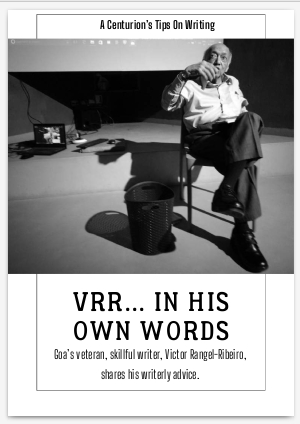
 Born in 1925 in the hamlet Porvorim, Victor Rangel-Ribeiro (whose name some of us in Goa arbitrarily abbreviated to VRR) lived his early life in the shadow of his father, who, he says, could do almost anything not just well but with panache. Victor Rangel-Ribeiro has had two, and more, career stints — one first in Bombay, and the second in the United States, encompassing several fields.
In education, he was a high school teacher in Bombay (now Mumbai), and in New York a teacher of illiterates, a teacher of the poor and the disadvantaged both young and old, a teacher of university students, and for a very short time a “teacher of pampered teenagers whose parents were so rich they did not give a damn about getting a good education”. b As a journalist, he has been a reporter, subeditor, and assistant editor in Mumbai, and has then written for the New York papers as well. In advertising, he became the first Indian to be copy chief with J. Walter Thompson Co. in Bombay. (This advertising holding company was incorporated in 1896 by the American advertising pioneer with the same name, later merged into Wunderman Thompson, and recently combined with another group agency VMLY&R, to create the new entity VML.). He was also the first Indian to be copy chief with a very small advertising agency in New York.
In music, Rangel-Ribeiro was a music critic with the Times and the Express in Bombay, and in New York he wrote music criticism for The New York Times. The International Chamber Orchestra, funded by the Ford Foundation in the 1960s, chose him as their first conductor and he led the group in its inaugural season.
In the late 1970s he was appointed music director of New York’s Beethoven Society and under his guidance they were invited to become a member of the very prestigious Lincoln Center of the Performing Arts. VRR began writing at a very early age, and his efforts were encouraged by both parents and siblings.
At St. Xavier’s College in Bombay, he started a writers’ club and a typewritten magazine. Late John Correia Afonso, the Indo-Portuguese historian, was a member; prominent ad man Gerson da Cunha joined later. His short stories began to appear in The Illustrated Weekly of India, and they were illustrated by Mario Miranda.
In New York, he stopped writing fiction but restarted again in 1988 after meeting in Bombay with Mulk Raj Anand. He also began editing manuscripts professionally, and edited some forty nonfiction books for such publishers like Macmillans. On the personal front, he adds: “In 1954, I married the very talented and beautiful young pianist Lea Vaz. Our partnership has endured and has enriched our lives. We have a daughter, Eva, and a son, Eric, and five grandchildren.”
Obviously, he has much to share. These are his words from across the decades.... released on October 3, 2025, the hundredth birthday of VRR.
Available only in e-book format.