
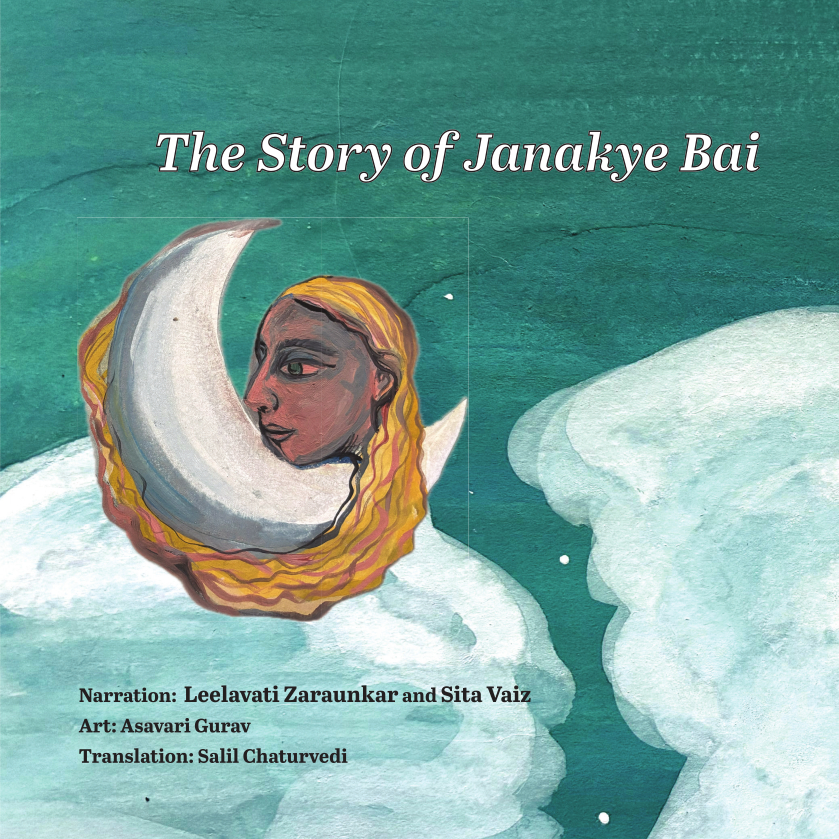
 The Story of Janakye Bai: A Velip Tale Finds Its Voice in a New Book
Narration: Leelavati Zaraunkar and Sita Vaiz Art: Asavari Gurav Translation: Salil Chaturvedi
The Story of Janakye Bai is a new publication that brings to readers a powerful knowledge system from the Velip community of Goa. Narrated by two traditional storytellers, Leelavati Zaraunker and Sita Vaiz, and illustrated by artist Asavari Gurav, the book is a rare documentation of a story that has lived for generations in the oral traditions of the Velips. The translation and editing by Salil Chaturvedi and the conceptual work by Vithai Zaraunker have helped bring this tale into written form without losing the cultural texture that makes it special.
The idea for the book grew out of a project entitled Old Songs, New Stories: Tales from the Velips of Goa. This work began when Vithai Zaraunker was a Master’s student in the Department of Sociology at Goa University. The project, sanctioned in 2014 under the Government of India’s scheme for Safeguarding the Intangible Cultural Heritage of India by Sangeet Natak Akademy, New Delhi, was strengthened through a research collaboration with Professor Kyoko Matsukawa of Konan University, Japan, supported by the JSPS KAKENHI (Japan Society for the Promotion of Science – Grants-in-Aid for Scientific Research, that supports cutting-edge work across all academic fields). The project was guided by the late Professor Alito Siqueira, who encouraged Vithai Zaraunker to explore the stories, songs, and cultural knowledge of her own community.
The story of Janakye Bai is important for many reasons. On the surface, it is a gripping folktale about a young woman who resists an attempt to force her into an incestuous marriage. But beneath the storyline lies the deeper moral code of the Velip community, which has long used stories to pass on values, warnings, and shared wisdom. The tale also reveals how tightly the community’s worldview is woven with nature and the spiritual realm. In capturing the voices of Leelavati and Sita, the book honours the knowledge carried by Velip women who have kept these stories alive in their memory despite many challenges.
The publication is also significant in the wider conversation about marginalised communities. Too often, the histories, languages, and stories of such communities are overlooked or dismissed as “dialects,” folklore, or material of limited value. When these voices are pushed aside, entire ways of thinking and understanding the world begin to disappear. Books like The Story of Janakye Bai remind us that every community has the right to narrate its own experiences, to value its own language, and to decide how its cultural heritage is shared with the world. Making space for these stories is not only an act of preservation, but is an act of justice.
“It took us over a year to bring this material into book form. The process taught me how challenging it is to represent a community from its own perspective. Turning oral traditions into written text is especially difficult because oral culture is never fixed. It changes with memory, mood, and the moment. You will notice this when you read the verses in the book and then listen to the songs through the QR code, the rhythm, words, and even the characters shift. Each time I tried to record a song or a memory, it came out differently, shaped by the storyteller’s feelings and the environment around them. This book is an attempt to honour that living, changing nature of oral tradition,” says Vithai Zaraunker, who is an Assistant Professor of Women’s Studies Programme, D.D. Kosambi School of Social Sciences and Behavioural Studies at the Goa University.
Along with the narrators and illustrator, field support came from Sagar Zaraunkar, Pankaj Zaraunkar, the late Sunil Gaonkar, Fondu Velip, Sangeeta Velip, and Manoj Velip. Their contributions ensured that the project remained grounded in the community from which the story emerged.
Published by Goa 1556, The Story of Janakye Bai stands as a tribute to the Velip people and is an invitation for all readers to listen to voices that have too long remained unheard.
“We have a series of books coming up in the future that will encourage the future generation to appreciate the knowledge system of their forefathers and challenge the existing as well as future scholarship through which the community is both romanticised and presented merely as backward and primitive,” says Vithai Zaraunker.
For further information and to order the book directly, please contact:
Email: vithaizaraunkar@gmail.com