
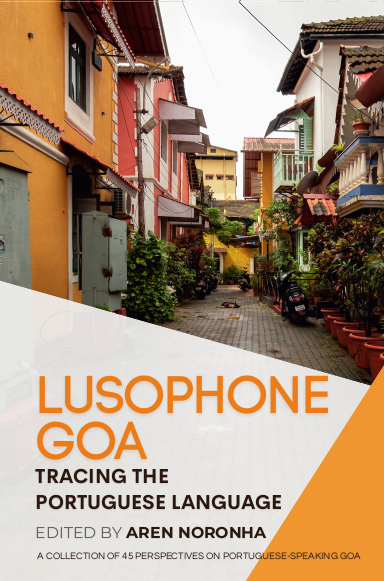
Is Portuguese a language of Goa’s past? Or does it have an unappreciated potential for its future too? That’s one of the issues raised by a new book. This book tracks lived memories about that language in this region, through the memories of 45 contributors.
Edited and compiled by Aren Noronha, 22, the book dives into the memories and journeys of people who still speak Portuguese in Goa. It also covers members of Goa’s wide-spread diaspora.
The book focuses on “Language, Memory and Postcolonial Inheritance in Goa and the Diaspora”.
From the stories of nearly four dozen contributors, descriptions take the reader back to a different Goa of the school and college times of another generation. In the process, it unravels slices of sometimes untold history as experienced by people of that era.
Portuguese was once the official language of Goa and other enclaves of Portugal in India. Yet, Portuguese was rapidly replaced by English in all administrative and education functions, after 1961. This was a language transition that wasn’t smooth or painless.
Intrigued by some questions encountered
Aren was, at the time of this work, a student of Portuguese and Lusophone Studies (MA) at the Goa University. He writes that the book came about as as he was intrigued by some of the questions he encountered.
Such as: What does it mean when a language grows, spreads, then suddenly shrinks, and largely
declines in a region? How does it change the collective identity of the place and the community?
What do its speakers feel about such changes? Answers to his questions come through “real and vivid” personal narratives, “some deeply moving”, as they narrate how people coped with the change.
There are perspectives from a wide range of personalities, many of them recognisable names.
Established writers like Fatima Noronha, José Lourenço, Xavier Cota, Bennet Paes; historians Délio Mendonça, Eufemiano de Jesus Miranda, Sharmila Pais; musicians like Dilip Chico and Omar de Loiola Pereira; IT professional Aulio Martins; expatriates from Brazil, Portugal, Mozambique, the US-based Luís Figueiredo, Edgar João, Carolina and Graça Costa, among others — share their varied journeys and thoughts. Former All India Radio executive Athos Fernandes takes us to origins in Dadra, Nagar Haveli and Daman and the language’s usage there. “There are people writing with absolutely different points of view and that is interesting”, Noronha adds.
Inadvertently, the work draws back the curtain on the education system in pre-1961 Goa, and not just as a dry treatise. The recounting is personal, it comes alive with feeling, atmosphere and sometimes “painful transitions”, when Goa swung lock, stock and barrel to English. But it also brings forth, especially via the essay of Goan-origin historian Sandra Ataíde Lobo, some of the process of the early collation of Konkani folk lore. This and some other narratives draw linkages between the Portuguese and Konkani languages in Goa. “The intermingling of cultures and languages” like loan words used in Malayalam, is also discussed in one essay on Kochi (Cochin). “I would have liked to expand the book to many more diverse voices, cultures and geographies. In fact, I did try very hard to get many more in,” he says, noting the limited time and reach.
As an exploration of the language’s past, present and future, the book also has new learners, non-speakers, teachers and students weighing in, as well. Looking ahead it suggests that Goa could leverage its Portuguese-language cultural footprint as an economic launchpad to connect India with the wider Portuguese-speaking world.
Examples of Macau, Timor-Leste, etc
Noronha draws on the examples of Macau, that has fewer native speakers than Goa, but where the language is actively promoted by China for economic gains among the Community of Portuguese Language Countries (CPLP), currently a combine of 39 countries. Another interesting pointer is to the case of the Portuguese language in East Timor (Timor-Leste).
India’s participation in BRICS also gives a new relevance to Portuguese, the main language of another large country of this major grouping of emerging economies, Brazil. The book marks several strains of thought with respect to the Portuguese language, all argued by different votaries. What it does, though, is open out the discourse for all of us to ponder.
Lusophone Goa: Tracing the Portuguese Language
Edited by Aren Noronha
ISBN 978-93-95795-48-7 (2026) Rs 700. Hardbound. Also available in paperback version.
US$13.95 incl. shipping internationally
The book is available at Rs 700 (hb) and Rs 600 (pb) in Goa. Postage extra Rs 35 if delivery required within Goa, Rs 70 within the rest of India.
For international orders, the book is USD $13.95 including postage anywhere internationally. To order a copy, please contact goa1556books@gmail.com or arennoronha@gmail.com, and email to confirm availability to your region before making the payment.
For more information about the book, see its website: https://lusophonegoabook.wordpress.com
See some online links to this book:
Book launch at XCHR: http://www.youtube.com/watch?v=IUqsd0TI3FM
The Portuguese in Asia — Article by Spencer Low, and sample of the book: https://www.portuguese.asia/post/lusophone-goa-tracing-the-portuguese-language
Agéncia Lusa (website requires a login, which can be created for free): https://www.lusa.pt/article/2026-02-09/46472823/aren-escreveu-um-livro-que-dava-45-filmes-com-goa-e-o-portugu%C3%AAs-como-cen%C3%A1rio
Hoje Macau (reproduced from Lusa): https://hojemacau.com.mo/2026/02/11/aren-noronha-recolheu-testemunhos-que-remetem-para-o-periodo-colonial-em-goa/
Pensando Goa (online presentation): https://www.youtube.com/watch?v=71Y8mDRIW4Q
O Heraldo (online and print): https://www.heraldgoa.in/cafe/from-goa-to-the-diaspora-portuguese-remains-a-living-heritage/462489/
Navhind Times (print): https://www.facebook.com/navhindtimes/photos/lusophone-goa-tracing-the-portuguese-language-edited-by-portuguese-ma-student-ar/1351655963644938/
The Saligão Balcão by Heta Pandit (Book Review): https://groups.google.com/g/goa-book-club/c/XSIBGv2pgGw/m/s_Fz62MHBAAJ
Revista da Casa de Goa (Article): https://casadegoa.org/revista/46
João Roque Book review: https://www.joaoroqueliteraryjournal.com/review-events-new/2026/4/8/lusophone-goa-tracing-the-portuguese-language
Scroll.in (excerpt from the book): A new book asks if the love for the Portuguese language in Goa is genuine or display of vanity https://scroll.in/article/1092159/a-new-book-asks-if-the-love-for-the-portuguese-language-in-goa-is-genuine-or-display-of-vanity
Discussion on review: https://groups.google.com/g/goa-book-club/c/gZvr-zf7FK8/m/-Dnxv7kRAAAJ